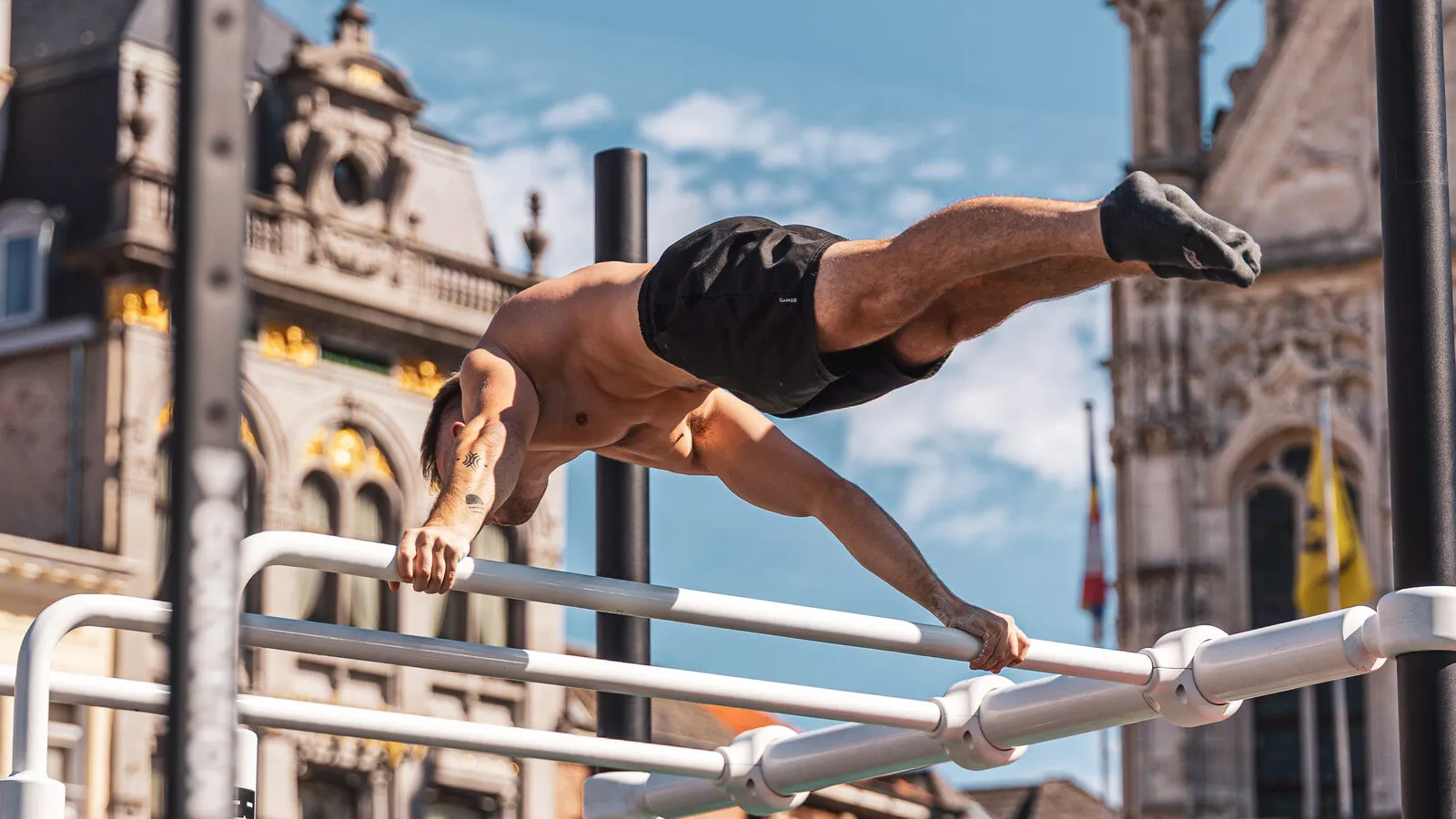
You hold a front lever for two seconds and you want to know what it is worth on competition day. The answer depends less on the skill than on the rulebook reading it. Two athletes can show the same position and walk away with different scores, because the panel is not looking at the same thing.
Two families of skills, and two disciplines that count differently
Everything you can show on a bar in freestyle lands in one of two boxes. Statics, where you hold a still position against your own bodyweight. Dynamics, where you build speed, let go of the bar and catch it again. Plenty of athletes are frightening in one box and invisible in the other. Most rulebooks know this and score the two separately, sometimes as two distinct workouts or two categories. The other two disciplines are not judged at all, they are measured. Endurance counts valid reps and streetlifting measures the kilos you add, and their movements are listed further down.
Statics are a leverage problem
A static is hard because your body sits far from the point of support. Tuck your knees in a front lever and the position becomes reachable. Straighten your legs and the leverage doubles the load on your shoulders and back. That is exactly what a judge reads. They do not score the position you announce, they score the one your body actually shows.
| Skill | What it takes | What a judge looks at |
|---|---|---|
| Front lever | Body horizontal under the bar, face up, the whole posterior chain loaded. | Hips level with the shoulders, legs straight, no swing on the way in. |
| Back lever | The same horizontal line but face down, shoulders in an extreme rotation. | Height of the hips, shoulder opening, arms locked from start to finish. |
| Planche | Body horizontal above the hands, arms straight, weight shifted forward. | Shoulder angle, locked elbows, hips that never rise above the line. |
| Maltese | A planche pushed further, arms out to the sides at chest height. | Depth of the arm position, straight body, real stillness rather than a passing shape. |
| Victorian | Body extended under the rings or the bar with the arms wide behind it, the rarest hold in the sport. | Body line, locked arms, open shoulders with nothing breaking at the hips. |
| Human flag | Body horizontal on a vertical bar, arms wide apart. | Body parallel to the ground, bottom arm straight, no twist in the trunk. |
| Iron cross | Arms wide on the rings with the body hanging in the middle. | Arms at shoulder height, stable wrists, no tilt of the trunk. |
| Inverted cross | An iron cross upside down, the body stacked above the rings. | Vertical body, arms at shoulder height, no tilt to either side. |
| Handstand | Vertical inversion on the hands, on its own or as the exit of another skill. | Straight line from hands to feet, no walking, controlled entry and exit. |
| Hollow back | A handstand with open shoulders and an arched back, the body carried behind the hands. | Shoulder opening, locked elbows, a shape held rather than passed through. |
| 90 degree hold | Body vertical and upside down on the hands or the bars, elbows bent to a right angle, chest level with the hands. | Elbow angle, body stacked over the shoulders, genuine stillness. |
| Elbow lever | Body horizontal, resting on the elbows driven into the abdomen. | Body parallel to the ground, feet touching nothing, a clear hold. |
| L-sit, V-sit and manna | Legs straight out in front on locked arms, higher and higher up to the manna. | Height of the legs, straight knees, hips that do not slide back under the shoulders. |
| Dragon flag | Body straight in the air on the shoulders, only the upper back in contact. | Body aligned from shoulders to feet, hips that never break, controlled descent. |
| One arm holds | Front lever, human flag or handstand held on a single arm, the top tier of almost every grid. | No help from the second hand, a shape held rather than brushed, controlled entry. |
Almost every one of these positions comes in tiers, tucked, one leg out, straddled then full, and a serious grid scores each tier on its own. A tucked front lever and a full front lever are therefore never worth the same, and it is the shape your body holds that decides, not the name you announce.
Dynamics are about making speed and catching it
A dynamic is over in a second. You load the bar, you release, you rotate, you catch. Difficulty comes from the number of rotations, the height of the release and whether you catch with one hand or two. A judge mostly watches the end of it. A big move caught in a scramble is worth less than a simpler move landed in silence.
| Skill | What it takes | What a judge looks at |
|---|---|---|
| Muscle up | Moving from a hang to support above the bar in one movement. | Transition without excess kip, straight arms at the top, controlled return. |
| Explosive muscle up | The same passage but released in the air, clapped or caught behind the bar. | Height of the release, firm regrasp, no help from the feet. |
| 360 | A full turn of the body around the bar after a release. | Height of the release, completed rotation, catch on both hands. |
| 540 and 720 | One and a half or two full turns around the bar on the same release. | Rotation fully closed before the catch, height of the release, tight body. |
| Geinger | A backwards release with a half turn, caught facing the bar. | Rotation finished before the catch, tight body, a firm regrasp. |
| Katchev | A straddled release over the bar, caught back in a hang on the other side. | Clear passage above the bar, straight legs, a catch with no jolt. |
| Shrimp flip | A forward release with a full flip over the bar. | Height above the bar, body line during the flip, clean regrasp. |
| Ice cream maker | A full rotation around the bar from the hang into support, never letting go. | Continuity of the rotation, arms staying straight as long as possible, a held finish. |
| Hefesto | Pulling from a back lever into support with the hands behind the back. | No swing, elbows finishing above the bar, a held position at the end. |
| Death jump | Releasing one bar to catch another one further away. | Distance covered, no foot contact, both hands landing together. |
| One hand catch | Any release caught on a single arm instead of two. | Free hand touching nothing, shoulder absorbing without slipping, body staying aligned. |
| Dismount flip | A front or back flip to leave the bar at the end of the run. | Landing on the feet and stable, tight body, no hand on the ground. |
| Bar combo | Several dynamics linked with no dead time between them. | Flow between the moves, no reset hang, quality of the last one. |
The movements counted in endurance
In endurance nothing is rated. The judge validates or does not, and what they validate goes to the total. The list of movements is therefore short and the standards are everything, the range, the starting position and what kills a rep. It all counts at bodyweight, nothing is added on the belt, and that is what separates endurance from streetlifting.
| Movement | What it takes | What a judge validates |
|---|---|---|
| Pull-up | Hang with straight arms then chin above the bar, overhand, underhand or neutral grip. | Arms fully straight at the bottom, chin clearly above, no leg drive when the strict version is asked for. |
| Muscle up | Moving from a hang to support above the bar, counted at bodyweight. | One single movement, locked elbows at the top, a full hang on the way down. |
| Dip | Lowering on the parallel bars to the required angle then locking the arms out. | Depth of the descent, straight arms at the top, no arching to steal range. |
| Push-up | Chest close to the ground then straight arms, body in one line from head to heels. | Full range, tight body, no rest with the knees down. |
| Bodyweight squat | Thighs at least parallel to the ground then back up with straight legs. | Depth of the descent, heels down, hips and knees locked at the top. |
| Australian pull-up | Horizontal pull under a low bar, tight body, chest to the bar. | Chest making contact, body in line, arms straight at the bottom. |
| Leg raise | Knees or straight legs lifted from a hang, up to the bar depending on the standard. | Height reached, no swing between reps, controlled descent. |
| Handstand push-up | Lowering head to the ground in a handstand, on the wall or free, then locking out. | Head making contact, locked elbows at the top, no hip break to help. |
| Burpee | Chest to the ground then a jump with the hands above the head. | Chest making contact, hips open at the top, both feet leaving and landing together. |
| Max hold | A hang, an L-sit or a handstand held as long as possible, counted in time and not in reps. | Position held without a break, clock stopped at the first slip. |
The movements loaded in streetlifting
In streetlifting the load replaces the score. Every federation keeps its own list, two movements in some of them with the pull-up and the dip, three with the muscle up, four once the squat is added, and the sum of the best valid loads makes the total. Each attempt is either valid or missed with nothing in between. Neither reps nor kilos ever go through a difficulty grid, so everything below comes back to judged freestyle skills.
| Movement | What it takes | What makes an attempt valid |
|---|---|---|
| Weighted pull-up | Load on the belt or in a vest, hang with straight arms then chin above the bar. | Straight arms at the bottom, chin above the bar, no kip when the strict version is asked for. |
| Weighted dip | Load hanging, lowering to the required angle then locking the arms out. | Depth reached, elbows locked at the top, load never resting on the ground. |
| Weighted muscle up | The full passage from the hang to support with the load attached. | One single movement, locked elbows at the top, no help from the feet. |
| Squat | Bar on the back, down to at least parallel then back to standing. | Depth, knees and hips locked at the top, bar racked on the signal. |
| Deadlift | Bar lifted off the ground to a locked standing position, where the federation keeps it. | Back holding its shape, knees and hips locked, bar lowered under control. |
What actually raises the difficulty
Three things decide. Leverage first, because the further your centre of mass travels from your hands, the more the position costs. Hold time second, because most rulebooks only count a static past a threshold, often two seconds of genuine stillness, and a shape you brush through does not count. Cleanliness of the exit last. Swinging into a shape, holding half a second and falling out of it is not the same as a controlled entry followed by a controlled exit.
How a panel turns a skill into a score
The mechanism is almost always the same. Each judge works from a grid that gives a value to every recognised skill, then applies deductions for execution faults. The raw value rewards what you attempted, the execution score punishes what you missed. Many formats add a third axis called composition, which looks at flow, use of the platform and variety. Judge scores are then aggregated, often after dropping the highest and the lowest, and the total feeds the leaderboard.
A difficulty grid is not a list of skills, it is a ladder. Skills sit in tiers, from the most reachable to the rarest, and each tier is worth a set number of points. Two skills in the same tier pay the same even when one feels far harder to you. That is why a sharp athlete does not show their favourite skill, they show the one that pays best for the risk it carries.
Why two competitions score the same skill differently
There is no universal scoring scale in street workout. Every organiser and every federation writes its own grid, and that grid reflects what they want to see on the platform. A format built around raw strength rewards long statics and straight arm positions. A format built around the show pays more for dynamics and long combos. The level of the field matters too. A skill that is rare in an open category becomes ordinary in an elite final, so the grid gets rewritten to keep separating athletes. Never assume your skill is worth elsewhere what it was worth last season.
What to read in a rulebook before you enter
Look for four things. The grid itself, or at least the list of recognised movements, because a skill missing from that list often scores nothing. The validation threshold for statics, in seconds. The run format, meaning the length of your set, the number of heats and the number of judges per station. And the repetition rule, because most rulebooks count a skill only once inside the same run. If any of that is missing, email the organiser before you pay your entry. A clear answer before the event beats an argument after the leaderboard is published.
Frequently asked questions
- None in absolute terms. It depends on the organiser's grid. A full planche or a 360 caught on one hand sit near the top of almost every grid, but the exact value changes from one event to the next.
- Most rulebooks ask for at least two seconds of clear stillness. Some go to three for the hardest positions. The number belongs in the rulebook and should never be left to the judge on the day.
- No. A rep is validated or refused and a load is lifted or missed, there is no difficulty value to argue about. The only grid those two disciplines have is the one holding the standards, what a rep must meet to count.
- It earns nothing and it burns time in your run. In many formats it also triggers an execution deduction if you touch the ground or lose the bar. Reaching far above your level is a gamble, not a plan.
- No. A clean run of mid tier skills often beats an ambitious messy one. Execution deductions eat the difficulty gap very quickly.
- Yes, and many do. Each workout keeps its own way of measuring the athlete, judged, counted or loaded, and the overall ranking adds up whatever the organiser decides to put in it, with the weight they give each workout.
- Check the list attached to the rulebook and compare the names. Naming varies between scenes, so describe the skill or send a short video if the name is not on the list.
